Trusted Medical Battery Guides

1. How Long Do AED Batteries Last and When Should You Replace Them?

Automated External Defibrillators (AEDs) are life-saving devices designed to deliver a shock to the heart in the event of sudden cardiac arrest. While AEDs themselves are simple to use, they rely entirely on their batteries to function. Without a reliable battery, even the best AED cannot save a life.

The lifespan of an AED battery depends on the brand, model, and how the device is used:

  • Philips HeartStart (M5070A): Typically 4 years in standby mode.
  • ZOLL AED Plus: About 5 years in standby mode with standard lithium batteries.
  • Physio-Control LIFEPAK 1000: Around 4 years in standby mode.
  • Defibtech Lifeline AED: Approximately 5 years in standby mode.

In general, most AED batteries last 2–5 years when the device is stored properly and not used frequently. However, frequent self-tests, harsh environments, or actual emergency use can shorten battery life.

Even if the expected lifespan has not been reached, your AED battery may need to be replaced earlier. Look out for these warning signs:

  • Low battery indicator light or show a red light on the AED
  • Beeping sounds or alert messages during self-checks
  • Shortened runtime during device testing
  • Expired date printed on the battery

2. Philips HeartStart AED Battery Guide (M5070A and More)

Philips is one of the most widely used AED brands in the United States, trusted by schools, offices, gyms, and healthcare providers. If you own a Philips HeartStart AED, choosing the correct battery is essential to keep your device ready to save lives. In this guide, we’ll walk you through the most common Philips AED batteries, their specifications, and when to replace them.

Philips HeartStart M5070A Battery

The M5070A is by far the most popular Philips AED battery.

  • Compatible devices: Philips HeartStart HS1, OnSite, and FRx AEDs
  • Standby life: Up to 4 years when installed in the AED
  • Capacity: Delivers approximately 200 shocks or 4 hours of continuous monitoring
  • Replacement schedule: Replace upon expiration date or immediately after use in an emergency
Philips FR3 AED Battery (989803150161)

The FR3 AED uses a different battery from the HS1/FRx series:

  • Compatible device: Philips HeartStart FR3 AED
  • Type: Rechargeable lithium-ion battery (model 989803150161)
  • Standby life: About 3 years or 300 charge cycles
  • Expired date printed on the battery
How to Know Which Philips AED Battery You Need
  • Check the AED model – The model name (HS1, FRx, FR3, FR2) is usually printed on the front of the device.
  • Check the existing battery – Look for the part number (M5070A, 989803150161, M3863A, etc.) printed on the label.
  • Consult the manual – The AED user guide will confirm the correct battery type.
  • Ask an expert – If you’re unsure, our support team can help you identify the right battery quickly.

3. ZOLL AED Plus Battery Replacement: What You Need to Know

What Battery Does the ZOLL AED Plus Use?

Unlike many AEDs that use a single proprietary battery pack, the ZOLL AED Plus uses 10 consumer lithium batteries (Duracell 123 or CR123A).

  • Type: Duracell 123 or CR123A
  • Quantity: 10 batteries per AED
  • Installation: Inserted into the back battery compartment of the AED Plus
Typical Battery Lifespan
  • Standby life: Up to 5 years if the AED is not frequently used
  • After use: If the AED delivers a shock or performs extensive monitoring, batteries should be replaced immediately
  • Low battery warning: The AED will emit beeping sounds and display a red “X” on the status indicator
How to Replace ZOLL AED Batteries
  • Power off the AED.
  • Open the battery compartment on the back of the device.
  • Remove all 10 used batteries.
  • Insert 10 new Aolstecell batteries.
  • Turn the AED on and run a self-test to confirm proper installation.

4. What is UN38.3 Certification and Why is it important

UN38.3 is a section of the United Nations Manual of Tests and Criteria. It requires all lithium batteries (both rechargeable and non-rechargeable) to pass a series of rigorous safety tests before they can be transported by air, sea, or land.

The certification includes 8 mandatory tests that simulate real-world conditions:

  • Altitude Simulation – Ensures batteries can withstand low air pressure.
  • Thermal Test – Exposes batteries to extreme temperature changes.
  • Vibration Test – Simulates vibration during transportation.
  • Shock Test – Tests battery resistance to sudden impacts.
  • External Short Circuit – Verifies protection against accidental shorting.
  • Impact/Crush Test – Ensures structural integrity under pressure.
  • Overcharge Test (for rechargeable batteries) – Confirms safety during charging.
  • Forced Discharge – Tests battery safety when completely discharged.

Only batteries that pass all 8 tests receive UN38.3 certification and can be legally transported.

Why Does UN38.3 Matter for Medical Batteries?
  • Safe Transport – Certified batteries can be shipped by air without restrictions, ensuring fast delivery to hospitals and clinics.
  • Risk Reduction – Minimizes the chance of fire, explosion, or leakage during use or shipping.
  • Regulatory Compliance – Required by international transport authorities (IATA, ICAO, DOT). Without UN38.3, a shipment may be rejected or delayed.
  • Peace of Mind – Healthcare providers know the batteries they use have been tested under the toughest conditions.

At MedicalBatteryDirect, every battery we sell is UN38.3 tested, UL certified, and FDA compliant, shipped quickly from US warehouses for your peace of mind.

5. FDA Compliance: What It Means for Replacement Medical Batteries

What Does FDA Compliance Mean?

The FDA classifies medical batteries as accessories to medical devices. Depending on the device they power, these batteries are generally considered Class I medical device accessories, which are subject to safety and manufacturing regulations.

Being FDA compliant typically means:

  • Registration – The manufacturer must register with the FDA as a medical device establishment.
  • Listing – The product must be listed with the FDA under the appropriate device category.
  • Quality System (QSR/ISO 13485) – Manufacturers must follow strict quality management standards to ensure consistent product safety and performance.
  • Labeling Requirements – Packaging and instructions must comply with FDA labeling rules to prevent misuse.

Only batteries that pass all 8 tests receive UN38.3 certification and can be legally transported.

Why FDA Compliance Matters for Medical Batteries
  • Patient Safety: In emergencies, an AED or ventilator must work instantly. FDA compliance ensures the battery powering it has been designed and manufactured to reliable standards.
  • Legal & Regulatory Protection: Hospitals, EMS providers, and clinics are required to use FDA-compliant components. Using non-compliant batteries may expose organizations to liability if a device fails.
  • Trust & Credibility:When you see “FDA compliant,” you know the supplier has taken the extra steps to meet US healthcare regulations. This builds confidence in both the product and the brand.

6. How to Identify the Medical Battery Model

①. Check the battery label
  • The most direct way to identify your medical battery is to look at the label printed on the battery itself.
  • Part number (P/N) – Usually a combination of letters and numbers (e.g., M5070A for Philips AED, 11141-000103 for LIFEPAK 1000).
  • Model name – Sometimes the battery is branded with the AED or device model it fits.
  • Always double-check spelling and numbers—confusing a single digit (e.g., “103” vs. “100”) can mean buying the wrong battery.
②. Check the Device Model
  • AEDs – Model name is usually on the front (e.g., Philips HeartStart FRx, ZOLL AED Plus).
  • Monitors – Look for the model printed near the display (e.g., Philips IntelliVue MP20).
  • Ventilators – Model often appears on the control panel (e.g., Respironics Trilogy 100).
  • Infusion pumps – Model is typically listed on the side or back.
③. Review the user manual

Every medical device includes a user or service manual. These documents list compatible accessories, including batteries and electrode pads.

④. Ask an Expert MedicalBatteryDirect

If you’re still uncertain, don’t guess. A knowledgeable supplier can help confirm the correct model before you order.

At MedicalBatteryDirect, our customer support team responds within 12 hours and can match your device to the correct certified replacement battery.
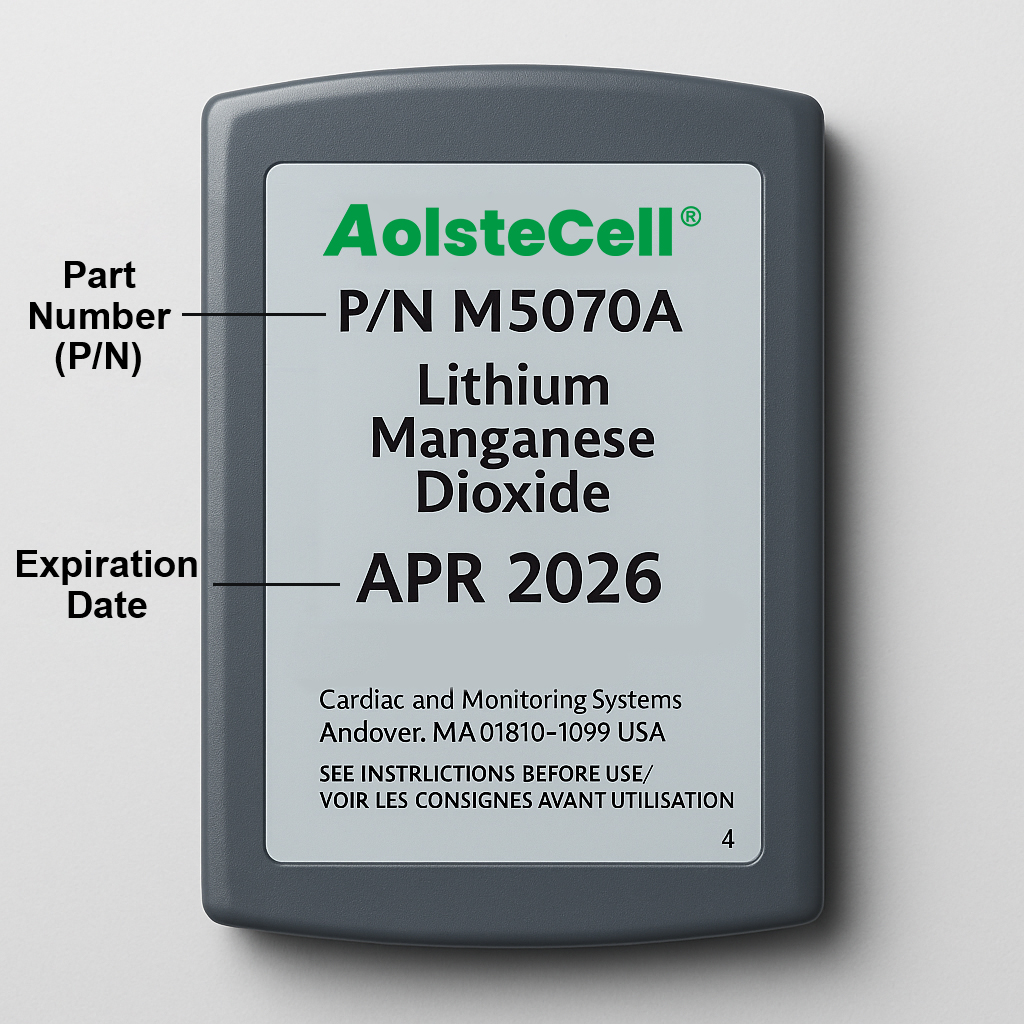
How to Identify the Medical Battery Model

7. How to Store Medical Batteries to Extend Their Lifespan

Proper storage helps ensure safety and reliability of medical batteries. Follow these key tips:

  • Temperature & Humidity: Store at 59°F–77°F (15°C–25°C) in a cool, dry place. Avoid heat, freezing, and moisture.
  • Charge Level: Keep rechargeable batteries at 40%–60% charge. Do not store fully charged or completely drained.
  • Check Regularly: Recharge every 3–6 months if unused.
  • Safe Handling: Use original packaging or insulated bags, keep away from flammable items, and avoid pressure or impact.
  • Before Use: Let the battery return to room temperature and check performance before installation.

8. Medical Battery Safety Precautions

To ensure safe and reliable use of medical batteries, follow these key guidelines:

  • Keep terminals covered to prevent short circuits.
  • Use only approved chargers; avoid overcharging.
  • Do not crush, puncture, or disassemble batteries.
  • Stop using if the battery is swollen, leaking, or damaged.
  • Dispose properly through medical or hazardous waste channels.